
• Skip to primary navigation
  • Skip to main content
  • Skip to footer
Park Power Logo

Park Power

Your Friendly, Local Utilities Provider

  • About
    • Why Park Power
    • How to Switch
      • How to Switch Electricity
      • How to Switch Natural Gas
      • How To Switch Your Cable Internet
      • How To Switch Your DSL Internet
    • Community Partners
    • Reviews
    • Blog
  • Compare Rates
    • Compare Electricity Rates
      • Compare Residential Electricity Rates
      • Compare Commercial Electricity Rates
      • Compare Farm Electricity Rates
      • Solar Club Electricity Rates
      • Compare Electricity Green Power Program
    • Compare Natural Gas Rates
      • Compare Residential Natural Gas Rates
      • Compare Commercial Natural Gas Rates
      • Compare Farm Natural Gas Rates
    • Compare Internet Rates
      • Compare Cable Internet Rates
      • Compare DSL Internet Rates
    • Utility bundles
  • FAQ
  • Contact
  • My Account
  • View Our Plans

Electricity

The Alberta Home That Can (Almost) Be Heated With A Hair Dryer

parkpower · 18 July 2019 · 1 Comment Consumer Info, Electricity, Interesting, Solar Power


By: Deanna McArthur

At first glance, Chelsah Thomas seems like your everyday Albertan. The 34-year-old new mother lives in Red Deer with her husband Jesse, who has a background in construction. 

Together, they built the home of their dreams, set against the river valley and surrounded by a thick patch of deciduous trees. 

It only takes about five minutes with Chelsah before you get a feel for the passion, and depth of knowledge she has about energy efficiency and passive home construction. 

Chelsah has a masters in Environmental Management with a focus on solar energy from Western State Colorado University. Today, together with her husband, she runs Sol Invictus Energy Services Ltd. (SIES), a socially responsible energy solution company.

That dream home she and her husband built together (The Thomas House) was Central Alberta’s first contemporary Passive, Net Zero (NZE) home.

Passive homes follow a German design standard that utilizes design materials and orientation in order to reduce a buildings ecological footprint. These ultra low energy buildings require little energy for space heating or cooling.  

The Thomas House was what led Chelsah to build SIES into the company that it is today. 

“The initial vision was to build a solar company with a social aspect to it,” said Chelsah. “But when we started thinking about building a Net Zero/Passive house, we couldn’t find any local consultants to help us with the process.”

Chelsah took matters into her own hands and completed a passive house design course. She is now a certified Energy Adviser through Natural Resources Canada. Together with the help of another consultant with passive house design experience, Bow Crow Design, they designed and built their home themselves. 

“Working on our own home made me realize how much I enjoyed working with residential energy and high-performance homes,” said Chelsah. “So, I decided to transfer the foundation of my company from solar to residential energy efficiency.”

The “Damn Near Passive” House
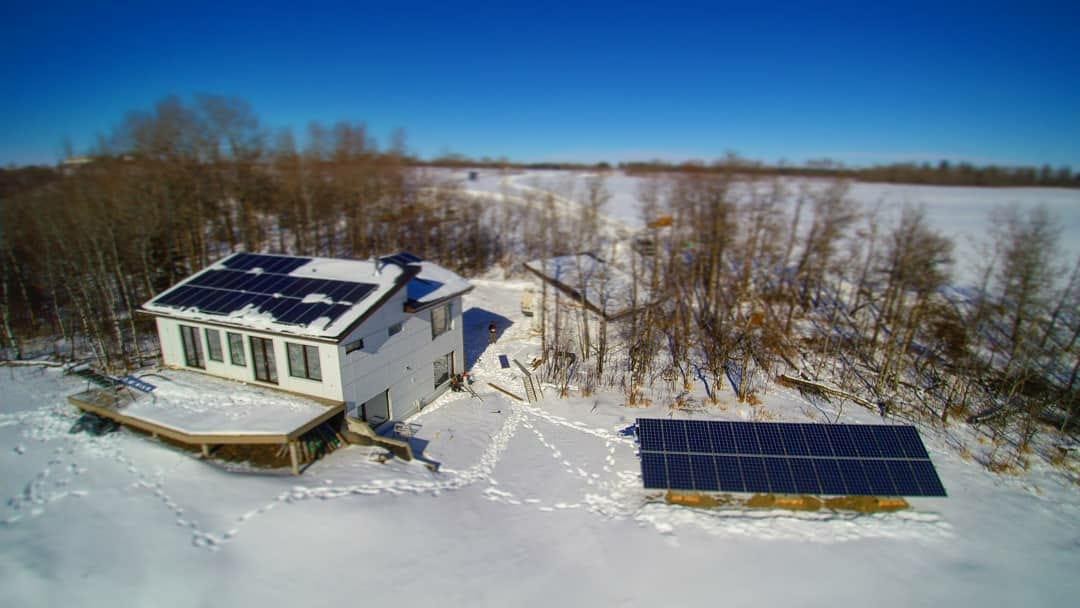
It took three years from concept to completion. The finishing touches on the Thomas House were completed in May of 2018 and Chelsah says they hope it can be used as an example for others looking to go the same route.

“We are hoping to use our house as a demo site for Albertans to see that a high-performance home is logistically and economically feasible in Central Alberta.”

Built into a hill, and with a walkout basement, the home is surrounded by deciduous trees, which allows for passive solar energy gain to be maximized during the winter, and be shaded from the sun during the summer. 

Some of the features of the home include:

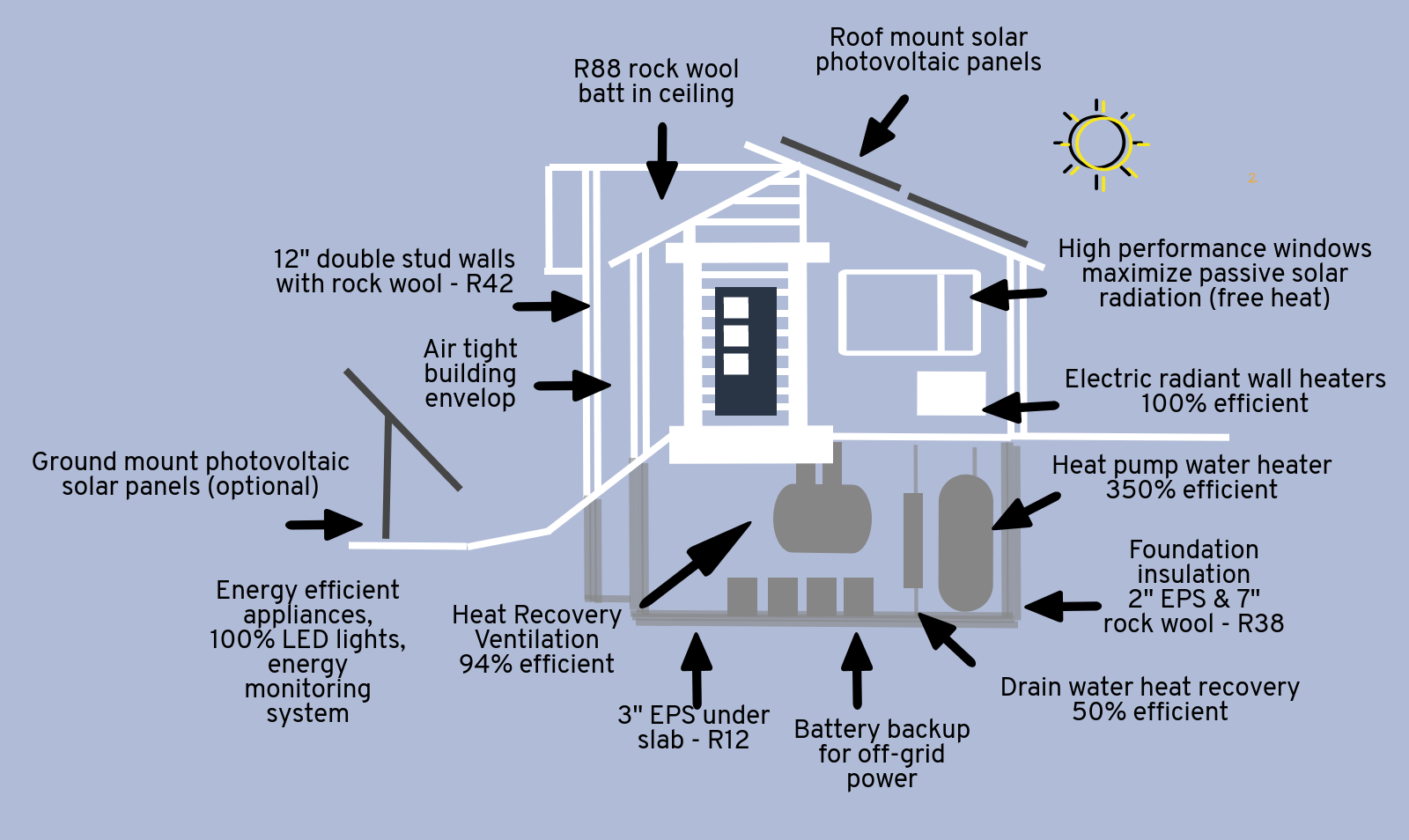
  • Two separate solar systems, a 12-kWh grid tied solar photovoltaic system and a 6 kWh off-grid battery backup solar PV system.
  • High performance heat recovery ventilator that meets Passive House standards. This brings in pre-warmed fresh air with a high MERV filter to filter out pollen, dust, smoke, exhaust allergens, and more, which increases the indoor air quality.
  • High efficiency heat pump hot water tank which is 350% efficient and uses indoor air to heat the water. With WIFI connection and a built in application, it can be controlled wirelessly and it is easy to monitor its energy consumption.
  • Powerpipe drain water heat recovery system installed to recover 53% of heat energy from shower and appliance wastewater, transferring the energy back into the hot water tank, reducing energy requirements and saving on energy costs. 
  • LED lights.
  • High efficiency “smart” appliances that can be managed remotely through apps. Appliances can be set to turn on during high solar times, rather than using grid electricity.
  • Smappee Energy Monitoring system which shows in real time, the homes consumption and generation, including utility costs associated with consumption.
  • High efficiency windows that meet Passive House standards 
  • Recycled rubber roofing.
  • High efficiency toilets offering 20% water savings.
  • Passive house cat door with a magnetic airtight and weatherproof seal. 
Now that construction has been completed and winter has passed, Chelsah says they are now focusing on completing some exterior work. The landscaping will include a holistic permaculture approach to sustainability where they can maximize ecosystem services provided by the landscape.

“We are planning to utilize xeriscaping, which is a landscaping philosophy that uses as many native, drought-resistant plants as possible to help limit our water use. We also have plans to utilize vermiculture, grow fruits and veggies on site, and a little further in the future, raise chickens.”

Although it doesn’t quite make the cut to be fully certified as a passive house, Chelsah is proud of their “damn near passive home” which has a total energy load that is about 64% less than a conventional home and a heating load 77% less. The house is so energy efficient, you could almost heat it with a blow dryer. 

Plus, with the added solar systems, Chelsah expects that their home will actually be net positive, meaning it is so efficient it produces more energy than it consumes.

Chelsah has joined the Solar Club, like the one offered by Park Power. This electricity rate plan and loyalty program helps her maximize the benefits she receives from her solar system.

“It is important to find a way to maximize the benefits of solar energy financially, both for ourselves and our clients, so that the cost of building a net zero home is offset by lower energy costs,” she said. 

“We were looking to make more money on energy exported to the grid, and we found Spot Power’s 18.75 cent/kWh rate. Utilizing this rate in the summer and then switching to the lower rate at the end of October just makes financial sense. I have estimated that the Solar Club could save the clients of one of our projects hundreds of dollars a year.”

The Thomas House vs the Alberta Winter

How does a home like this hold up against the harsh Alberta winters? This years bitingly cold February was a perfect opportunity to test the performance of the design. 

“I have to be honest, the motherly instinct in me was a little apprehensive when the cold winter weather started rolling in,” said Chelsah. “The home has no furnace, and I had a new baby. Were we going to be able to stay warm?” 

“It can be scary in Alberta to not be on the grid as far as natural gas, because that does feel like a constant secure access to energy,” she added. “But we made it! We were comfortable and we were warm.”

Normal winter conditions in Central Alberta have an average temperature that ranges between -2⁰ to -16⁰ Celsius. During these regular days, the home maintained a very comfortable living temperature with little effort. 

The high levels of insulation, with limited heat loss through air leakage, and passive solar heat gains, all contributed to the minimal temperature fluctuations in the home. Although, additional heat in the form of a small radiant electric heater was required in order to “top up” the heat, especially at night, while some days they used a wood stove for heat. 

Benefits of Passive House Design

The benefits of a green home go far beyond just energy savings, according to Chelsah. These types of homes also:

  • Have cleaner indoor air quality because of their use of heat recovery ventilators. These filter air as it comes into the house, which removes allergens, toxins and pollution.

  • Use low Volatile Organic Compound (VOC) paint and adhesives. VOCs are found in many building materials. These chemicals let off gasses that are harmful to people and the environment and can contribute to health problems.

  • Are more comfortable. Since they are well insulated and practically airtight, they maintain indoor air temperature more regularly and you don’t feel the drafts you would in a typical home.

  • Have higher resale value. Net Zero homes receive a 4-10% premium when they are resold. Buyers recognize that these homes have higher construction quality, and come with other added benefits such as continuous energy production.

  • Are more resilient. The environment in the home is regulated so well you don’t feel the effects of day to day weather fluctuations as much as you would in other homes. 

“Even our solar panels are resilient,” said Chelsah. “We have had some major hail storms, and our solar system remains damage free, while our family wrote off four vehicles.”

Engaging More Homeowners in Alberta

According to Chelsah, passive home design is not well known in Alberta. 

“Most people assume that how homes are constructed in Alberta is the best way it can be done,” she said. “But that is not necessarily the case. Most are building to a minimum code standard, which is not doing anyone any favours in relation to efficiency.” 

With any new technology, it takes time to catch on with consumers. 

Chelsah hopes that SIES will not only be able to help spread the word and guide Albertans through the journey of building a high-performance home, but will also develop a network of like-minded professionals in Alberta to create a hub for high-performance home design and solar professionals in Alberta. 

“Building a community of professionals will allow us to share information and best practices with each other, benefiting the industry and consumers overall. It is also essential that the professional community is educating people on energy consumption and increase the overall energy literacy of Alberta.”

To learn more about Sol Invictus Energy Services Ltd. and eco-homes visit solinvictusenergyservices.com. 
Oil, gas, wind, and solar together are the next generation Alberta energy equation, says solar installer

parkpower · 27 June 2019 · Leave a Comment Consumer Info, Electricity, Solar Power

By: Deanna McArthur

The fate of solar rebate programs in Alberta are still undecided as the new UCP government continues to review and assess programs funded by the now defunct carbon tax. 

A local solar installer says there’s no reason why the solar industry shouldn’t continue to grow and receive support. 

“If you look at what the new government identified as their key priorities – economy and jobs – the good news is that solar is a great contributor to each one,” said Geoff Domenico, President of KCP Energy. 

Based on discussions with his fellow Alberta installers and those knowledgeable in the industry, Domenico estimates that there are close to $150 million worth of solar projects that are currently on hold. This is because the government is currently in the process of deciding if it wants to continue funding programs that were previously offered under the banner of Energy Efficiency Alberta (EEA). 

“In our case, we have signed contracts or at minimum, letters of intent, for 100% of our projects that are currently being held up,” said Domenico. “These are contracts between our company and farmers, homeowners, and businesses.” 

“Let’s not forget contracts that are in place throughout the solar supply chain which could include everyone from solar equipment distributors all the way to manufacturers. Allowing these projects to move forward ensures high value Alberta energy jobs for electricians, engineers, marketing, sales people, and many others are secured into the future.”

Room for Even More Growth

Recently, the US passed 2 million solar installations. The 2 million mark comes three years after installations hit 1 million, a figure it took the industry 40 years to reach. Wood Mackenzie, a world-renowned data collection consultant, is forecasting that installations will reach 3 million in 2021 and 4 million in 2023.

Alberta has seen huge growth in the solar sector over the last couple of years. According to the Alberta Electric Systems Operator microgeneration reports, the number of solar micro-generation sites in Alberta have grown from 1,870 in June 2017, to 3,689 in March 2019. 

Based on numbers provided by EEA, Domenico estimates that Alberta is installing about 1,200 systems per year. Although the province has seen impressive growth since 2017, it is not even close to matching the pace of our southern neighbour.

“Alberta would have to expand its growth by about six times to catch up with and be installing at the same pace as what is happening in the States,” said Domenico. “There should be no discussion on reducing or slowing down the solar installations in Alberta. We don’t have time to pause, we are behind and we have a lot of catching up to do.”

Alberta’s solar industry should be focusing on how to grow to meet this huge growth target, and on creating more jobs, while growing Alberta’s economy. We should not be worrying about the impact of paused programs, adds Domenico. 

“This is completely in line with the goals of the new government,” said Domenico. “The government is pro business and the solar industry is pro business. It all fits together.”

Finding Synergies in Alberta’s Energy Landscape

It’s not just the solar industry alone that Domenico believes will play an important roll in Alberta’s future; oil, gas, and wind all do their part.

“The new government has the opportunity to highlight and identify all of these great energy sources we have in this province,” he said. “We have oil and gas and we should be doing everything we can to make those energy sources as successful as possible. Additionally, we have great wind and solar resources, and we should be looking at every opportunity to grow these Alberta energy sources as well.”

On the tails of a new report by the Conference Board of Canada that says Alberta could fall back into a recession this year, focusing on how all energy sectors in Alberta can help the province will be more important than ever.

Domenico believes that the four different energy sources, working in tandem, are the next generation Alberta energy equation.

“Oil and solar are not mutually exclusive. We have to move forward by finding a way for all of these different energy technologies to work together,” he said. “Albertans are keen to be a part of all of Alberta’s different energy industries. We need everything firing on all cylinders, in every segment that we have been blessed with in this province. Why are we not doing that?”

Additional Money-Making Opportunities

One of the reasons the solar programs launched under Energy Efficiency Alberta rubbed some Albertans the wrong way is because many believed the government was just doling out free money to those that wanted to put solar on their home, says Domenico. 

“In actuality, for a good portion of the programs, the Government retained the rights to the future environmental attributes of the systems,” he said. “Instead of giving away money, the Government was actually buying and now owns these attributes.”

Environmental attributes are renewable energy credits, benefits, or emissions avoided by the installation or implementation of technology. In this case, the technology was PV solar. When micro-generators are generating electricity, this reduces the amount of electricity needed to be generated and shipped to the grid by conventional sources such as coal or natural gas. 

According to Domenico, based on the tonnes of emissions avoided through the solar program, environmental attributes now owned by the government are potentially worth millions of dollars in the Alberta carbon market.

Unfortunately, we do not believe the government currently has a system in place to certify or monetize these environmental attributes. This seems like an untapped money-making opportunity for the new government, says Domenico.

“It was pretty exciting when we realized the incentive was not in fact an incentive, but the government purchasing something real and tangible,” said Domenico. “If the government could find an effective way to bundle the small carbon offsets and sell them to high emitters there would be a real income potential there.”

Growing Solar Sector Helping Province Meet its Goals

As part of Alberta’s current Climate Leadership Plan, a goal of having 30% of Alberta’s electricity generation come from renewable energy by 2030 was set. In order to achieve this goal, the Alberta Electric Systems Operator (AESO) held a series of competitive procurements (REP) to encourage the development of new renewable electricity generation in Alberta.

Round 1 of REP was held in 2017 and resulted in four proposed renewable electricity projects, with an aggregate generating capacity of 595.6 MW. These projects will be built and come in service by December 2019.

Rounds 2 and 3 of REP were held in 2018 for projects that will be built and come in service by June 30, 2021. The last two rounds resulted in an aggregate generating capacity of 763 MW.

Taken together, the REP results mean that 1,358.6 MW of new renewable generation will be built in Alberta by June 30, 2021.

But it’s not just large renewable energy companies that are helping with the electricity transition in Alberta, its everyday Albertans as well.

According to Domenico, his clients typically install solar systems which will produce between 70% and 100% of their home’s annual electricity usage. According to Alberta’s micro-generation regulation, any electricity that is generated above and beyond the home’s needs can be sold back to the electricity grid. 

The increase in solar installations over the last few years means more green energy being produced overall, further helping to green Alberta’s electricity grid. 
Thanks to the introduction of innovative products and services by local companies, those solar installations are having an even larger impact. 

The Solar Club, a unique program created with Alberta PV Solar Micro-Generators in mind and offered by a number of local Energy Marketers in Alberta, hopes to encourage even more micro-generation investment in the province. 

The Solar Club offers members exclusive electricity retail rates, which are designed to help maximize the profit earned from the excess solar electricity being generated by micro-generators and shipped back into the grid. The Club is a private initiative promoted by Park Power and others – not funded by government taxes.

Club benefits include an annual “cash back” cheque as a customer loyalty benefit. Additionally, 30% of the electricity a Micro-Generator member buys from the grid to supplement what his own solar system falls short in producing is offset with Renewable Energy Certificates (RECs) purchased from Green Alberta Energy; absolutely free. Added on top of this the Club member can also pre-pay their monthly utility in voice using Mastercard and earn points. Joining the club comes at a small cost, members are asked to make a donation to their local food bank.

“Membership has its benefits. This is an innovative program for PV Solar Micro-Generators,” said Nick Clark, Director of Green Alberta Energy. “Earn more, get cash back, help green the grid and lower your monthly utility invoice. Plus if you install solar you are helping employ local installers in Alberta.”

Solar Knowledge is Power

parkpower · 31 March 2019 · Leave a Comment Consumer Info, Electricity, Interesting, Solar Power

On Saturday April 6, 2019, join Park Power at the 2019 Solar Trade Show presented by the Solar Energy Society of Alberta. in Edmonton at NAIT.

Park Power is proud to be an Equinox Sponsor of this FREE Solar Trade Show and we will be 1 of 50 interactive booths exhibiting at the show. Attendees will have the opportunity to learn from leading pros about renewable and energy efficient practices at the 14 workshops being held. As well there will be an Electric Vehicle Showcase, Food Trucks and Family Friendly Activities.

As it is provincial election campaign time, there will be an All Party Forum on Renewable Energy to kick off the event (10:30am-12pm). Hosted by Graham Thomson this should prove to be an enlightening event showcasing each party’s stance on renewable energy.

At Park Power we have always been “Solar Friendly” and at the 2019 Solar Trade Show we will be promoting our new Solar Club Loyalty Program. Come on down and talk to Kris about why switching to Park Power offers a tonnes of value for any grid tied Micro Gen consumer with solar pv on their roof.

Below is a schedule of the days events. See you there!

Trade Show in Edmonton to Shine a Light on Solar Power in Alberta

parkpower · 25 March 2019 · Leave a Comment Consumer Info, Electricity, Solar Power

Passionate about solar energy, electricity, and the future sustainability of our province? Well there is an event coming up you may want to attend.

The Solar Energy Society of Alberta (SESA) is hosting a free Solar Trade Show Saturday, April 6, 2019, at the NAIT CAT building, which will provide a great opportunity for those in attendance to network with solar enthusiasts.

The topic of solar has been pushed into the spotlight in Alberta recently and The Solar Trade Show will provide a number great resources for attendees looking to get involved in Alberta’s renewable energy future. There are a number of workshops planned, led by top industry professionals, to help educate consumers on a wide variety of topics including solar training opportunities, solar PV return on investment, financing solar projects, and much more.

In the summer of 2017, Energy Efficiency Alberta, a government agency dedicated to helping the province save energy, announced the Residential and Commercial Solar Program. The program offers rebates to homeowners, businesses and non-profits to install solar photovoltaic (PV) systems. With the program, homeowners can get up to 30% off solar panel installation, for a maximum rebate of $10,000, and businesses and non-profit organizations can get up to 25% off system costs, to a maximum rebate of $500,000. It is no surprise that solar power is top of mind for many in the province.

Since the program launched, more than 500 households and businesses have applied to participate in the Residential and Commercial Solar Program. When all approved installations are complete, this will represent 16 MW of new energy enough to power 2,700 homes for one year.

According to Energy Efficiency Alberta, by 2019 the program is expected to:

  1. Support the creation of jobs in Alberta’s solar sector.
  2. Cut solar installation costs by up to 30% for residences.
  3. Cut solar installation costs by up to 25% for businesses and non-profits.
  4. Reduce greenhouse gas emissions in the province by about half a million tonnes (the equivalent of taking 100,000 passenger vehicles off the road).

Attendees to the Solar Trade Show can expect to see variety of exhibitors ranging from solar installers, to educational providers. Kris Kasawski, Founder of Park Power, a local Energy Marketer who offers competitive energy rates to Albertans, will also be exhibiting.

Before launching Park Power in 2013, Kasawski spent time working with his brother Kyle, a 15-year veteran of the solar industry in Alberta. Kasawski remains passionate about its future development in Alberta. Visitors who come to see the Park Power booth at the SESA Trade Show can expect to meet a friendly face who can answer any questions they may have about having a grid tied solar system as well as learn more about their choices as a consumer in the Alberta utilities market.

Kris Kasawski, Founder of Park Power is passionate about the future of solar power in Alberta.

“I am hoping to show consumers with solar PV systems that there are better choices for electricity providers available to them,” said Kasawski. “Not only are there companies out there that offer great Alberta based customer service and share their profits with awesome local charities, there are companies that provide premiums for solar PV micro-generation customers.”

Micro-generation is the production of electricity on a small scale, using renewable and alternative energy sources. Energy sources are typically solar and wind that are generated by individual home owners and small businesses, as well as municipal and community buildings to meet their electricity needs.

The micro-generation regulation, which was established in 2008, allows Albertans to meet their own electricity needs by generating electricity from renewable or alternative energy sources. In 2016, the regulation was amended to provide more flexibility for rules on how Albertans can generate electricity. One of the most notable changes was the size limit increase from 1 MW to 5 MW.

Under the regulation, micro-generators receive credits for the electricity they produce but do not consume. Micro-generators are paid for the electricity they export to the grid at the same rate they pay to import electricity from the grid. For example: If a customer is paying 6.30 cent/kWh for electricity imported from the grid, they will then be paid 6.30 cent/kWh for any electricity they export back to the grid.

In partnership with Utility Network and Partners Inc. (UTILITYnet), and Green Alberta Energy, Park Power and a number of other Energy Marketers in Alberta are offering the opportunity for Solar PV MicroGenerators to join our SOLAR CLUB Loyalty program.

“The Solar Club Loyalty program can help solar customers increase the earning potential of their solar system,” said Kasawski. “The fact that we offer a High Export Rate means that a customer with a solar system can earn more from their system in the high production months.”

When should Albertans start to think about investing in solar? Now is the time, according Kasawski.

“The future for solar in Alberta looks bright. We have a very good solar resource province wide and areas of South Eastern Alberta are some of the sunniest in Canada,” he said. “Having solar on your roof immediately reduces your electricity bills and as the price of solar continues to decline, and electricity prices climb from the 2017 record lows, the return on investment gets better. With the government incentives available, right now is a great time to consider solar as an investment for both residential and commercial applications.”

This is an exciting time for Albertans looking to get involved in the renewable energy sector and the upcoming SESA Solar Trade Show will be a great opportunity for Albertans to learn more about the options available to them.

If you already have solar on your home perhaps you should consider making Park Power your electricity provider to take advantage of our Solar Club Loyalty Program.

[tw_button link=”https://secure.parkpower.ca/mysecure/signup.html” size=”medium” rounded=”false” style=”flat” hover=”default” color=”#d1512a” target=”_blank”]Sign Me Up![/tw_button]

Learn More About Electricity in Alberta

[mc4wp_form id=”1180″]

New free software helps Albertans dive into renewable energy

parkpower · 4 February 2019 · Leave a Comment Consumer Info, Electricity, Interesting, Solar Power

There’s no escaping the topic. You read about it in the news, experts are talking about how renewable energy will change the way we power our lives, and now, there are even rebates from the government available.

Whether its by sunlight, wind, or geothermal heat, renewable energy has the ability to reduce a consumer’s carbon footprint as well as their utility bill.

With installation costs continuing to fall for certain renewable technologies, and electricity prices on the rise in Alberta, more and more consumers are starting to consider some type of renewable energy system for their home or business.

Even with these incentives, some barriers still exist. Most notably, understanding how to get started.

A new software start-up from the Sherwood Park area is looking to make renewable energy more approachable for Albertans.

Ripple Design Studio is a platform which both the general public and professional engineers can use to determine which alternative energy sources are right for their home or development project.

“Our goal is to create a new standard for energy modeling software which is free and easy to use, in order to support the growth of the alternative energy sector,” said Evan Smith, Solutions Architect at Ripple Design Studio. “Our software can quickly model anything from a few solar panels to offset a home’s electrical bill, to a fully functional independent microgrid capable of sustaining a community while generating usable energy surplus.”

In the past, existing energy modeling solutions were hard to use and even straightforward assessments could take days or weeks depending on what information was readily available. As a work around, many industry professionals had developed their own complicated spreadsheets to manage their projects.

The Ripple Design Studio team believed that an application that could provide basic feasibility studies with minimal data entry and no training required would save countless work hours on every project.

“We wanted Ripple Design Studio to be accessible to everyone and support multiple energy options right from the get go,” said Smith. “We’re also hoping it will be used as an educational tool, making alternative energy accessible to anyone who wants to know more about the various technologies currently available.”

How it works

It’s not just understanding what type of a building you have, or what you are currently paying for electricity, consumers considering an alternative energy installation need data on weather, the energy profile of their building, and more. Finding accurate information for a particular region can be an ordeal and often prevents people from pursuing alternative energy options and connecting with the resources they need.

Ripple Design Studio makes it significantly easier to get started. With just a location and a project in mind you can quickly determine what the equipment sizing and energy requirements are from its simple and easy to read reports.

“As we see it, one of the main hurdles surrounding the wide-scale implementation of alternative energy is that consumers typically need to take on researching their options and locating the right suppliers all by themselves,” said Smith. “Ripple Design Studio lets you create a project with as few details as possible, and once you generate results you can connect directly with vendors who specialize in exactly the type of equipment and services you need to complete your project.”

In just five easy steps, Ripple Design Studio can help any homeowner with their alternative energy project.

Step 1: Set Location

Your project’s location determines the environmental data used for feasibility estimates of your chosen alternative energy sources. Ripple Design Studio uses climate data from all over the world to project the lifetime performance of the energy system.

Step 2: Choose Building(s)

Ripple Design Studio has a library of Building Models and specifications derived from detailed ASHRAE standards. Choosing building type and area automatically calculates annual energy demand.

These heating, cooling, and electrical energy estimates are then used to determine your system requirements when switching to alternative energy.

Step 3: Add Rates

Financial analysis is as easy as knowing what you currently pay for electricity and natural gas. Simply input your rates and fees for a selected period and Ripple Design Studio will project annual and lifetime savings when switching to alternative energy.

Step 4: Select Components

Select alternative energy sources like solar panels, geothermal, and more then watch Ripple Design Studio simulate an efficient micro-grid system.

Electrical and thermal storage components utilize surplus energy generated throughout the year for even more benefit.

Ripple Design Studio gives you options to allocate energy, select equipment size, and determine if your project is on or off-grid to create a truly integrated or independent alternative energy system.

Step 5: Review your Report

A Report detailing your project is automatically generated as you create an alternative energy system, including expected performance and specifications for the equipment required.

You can review any of the Project pages and make further changes to fully customize your ideal micro-grid System.

Options for alternative energy are more than just solar

There is no doubt that when most people think about renewable energy for their homes, the first thing that comes to mind is solar power.

Although solar can be a great way to reduce your electricity costs and your carbon footprint, it might not work for everyone, and there are many other options available, explains Smith.

Most Albertans probably don’t realize that geothermal heating is an option in our climate. In fact, the average underground temperature in Alberta stays around 6-7⁰C all year.

Heat pumps and exchangers can extract this ambient energy and modern thermal storage technology allows your heating system to store any extra thermal energy you produce under the ground for later use.

Combined Heat and Power (CHP) generators are also an appealing option. These are power generators which use a low emission fuel like natural gas or diesel to generate electricity and utilizes the thermal energy created from generation as the primary source of heat for the system.

“A well-maintained CHP can generate 1.5 times as much heat energy as electrical energy and can be scaled for use in home, community, or industrial projects,” said Smith.

The future of alternative energy modeling software

The general public can sign up now. It’s fee and easy to use.

As the platform continues to evolve, Smith says new features and functions will be rolled out. Electrical storage (batteries) and wind power are next on the agenda to be added to the basic version. Additionally, new charts and infographics are being added based on user feedback to streamline the interface for first time users while packing as much added functionality to the application as possible.

By the end of 2019 he says they hope to have an early release of the Engineering Edition ready for testing. This edition will allow for more in-depth simulation and modelling, allowing a user full control over their system design and preferences.

“Overall our focus is on user experience as we don’t want users getting lost in a complex interface or being overwhelmed with pages and pages of data input and obscure results,” said Smith. “We want our users to come away from Ripple feeling energized and ready to break ground on their project.”

Benefits for PV Solar Micro-generators

If you are thinking of adding PV Solar to your home or business, be sure to check out Park Power’s special solar rates and program. Most notably, our Light Up Alberta program, in partnership with Green Alberta Energy offers micro-generators a premium of 1 cent/kWh on electricity exported to the grid.

As we move into 2019, the Light Up Alberta program will be dramatically enhanced. The new program will help micro-generators become 100% green. Stay tuned.

  • « Go to Previous Page
  • Page 1
  • Interim pages omitted …
  • Page 3
  • Page 4
  • Page 5
  • Page 6
  • Page 7
  • Interim pages omitted …
  • Page 15
  • Go to Next Page »

Footer

Contact Park Power

Customer Support
780-640-2128

customercare@parkpower.ca

General Inquires

info@parkpower.ca 

Community Partnerships

community@parkpower.ca 

Park Power

BOX #454

314 – 222 Baseline Road Sherwood Park AB 
T8H 1S8

Social Media

  • Facebook
  • Instagram
  • LinkedIn
  • Twitter

Accreditations

Edmonton Made Logo - Accreditations for Park Power

Privacy & Legal

Park Power is an energy marketer for UtilityNET (Utility Network & Partners Inc.). Park Power operates under UtilityNET’s Electricity and Natural Gas Marketing Business License issued by Service Alberta, a Ministry of the Government of Alberta. You are free to purchase electricity and natural gas from the provider of your choice. The delivery of natural gas and electricity to you is not affected by your choice. If you change who you purchase natural gas or electricity from, you still receive natural gas and electricity via the distribution company in your service area. For a list of energy providers you may choose from, visit ucahelps.gov.ab.ca or call 310-4822 (toll-free in Alberta). Some offers, in whole or in part, may not be available in natural gas co-ops, municipally owned utilities, and some rural electrification associations. Copyright © 2026 Park Power Ltd.